
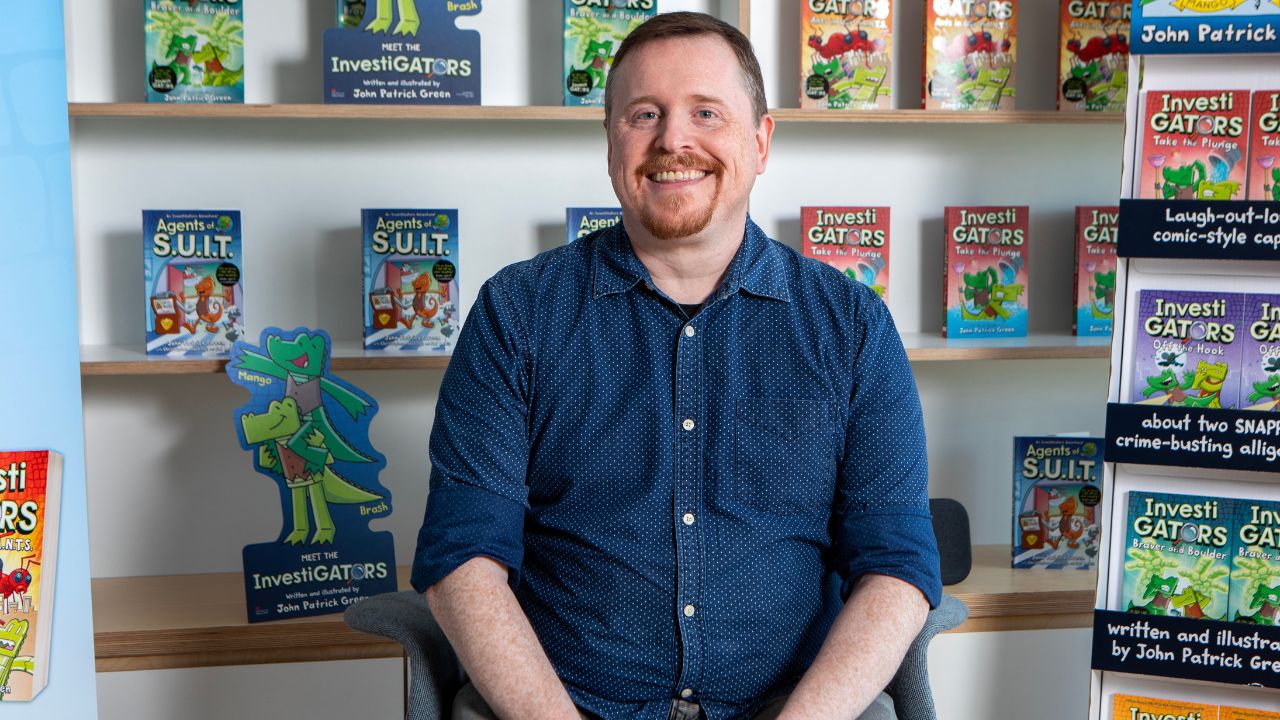
The InvestiGators creator on humour, graphic novels as a literacy gateway, and “solving a mystery one word at a time”
“The author’s talk was great; really interesting and memorable.”
“A.MAZ.ING! I loved it.”
“It has inspired me to start storytelling.”
The reactions from children after John Patrick Green’s Emirates LitFest session capture the magic that lingers long after the festival ends: the stories—and the ideas—keep going.
Green is the writer and artist behind the InvestiGators middle-grade graphic novel series, which follows two crime-solving alligators working for an undercover spy agency. With over four million copies sold worldwide, the books have hooked young readers across the globe.
A lifelong fan of comic strips and comic books, he has also created early-reader graphic novels including Hippopotamister and the Kitten Construction Company duology, co-writes the spin-off Agents of S.U.I.T., and co-created Teen Boat!.
In conversation at the Emirates Airline Festival of Literature, his message to parents is clear: graphic novels aren’t a shortcut around reading; they’re a powerful gateway into it.
What is it about Mango and Brash that makes them so instantly lovable to kids globally?
If I had to take a guess, I’d say it’s because they’re silly yet find themselves in serious situations that kids can still relate to. They have a dynamic that I think has a lot of appeal.
Where did the original spark for the InvestiGators come from?
When I began brainstorming ideas, I had just finished an early-reader graphic novel series called Kitten Construction Company. Before that, I did Hippopotamister, about animals trying human jobs. I realised I enjoyed drawing cartoon animals in work uniforms; there’s something adorable and relatable about it.
I then started thinking of animal puns and landed on the joke: “What do you call an alligator that solves crimes? An investigator.” The vests came next — “in-vest-igators.” That was the initial pitch. The world grew quickly, pulling in other strange ideas I’d had, which is how you end up with robot ghosts, dinosaur magicians and a universe that runs on what I’d call “plausible absurdity”.
Some parents worry that graphic novels “don’t count” as real reading. What would you say to them?
The worst thing a parent can say to a child who wants to read something is, “That’s not real reading. Read this instead.” You’re denying them a joyful experience and teaching them that reading is a chore.
You get better at reading by reading, no matter what you’re reading. Comic books still stretch that reading muscle. If children enjoy that form of reading, they’ll be more open to other forms later. The key to encouraging reading is to make sure you’re not discouraging it. Reading should feel like a discovery rather than an obligation.
Why does humour connect so powerfully with children?
Comedy is built on surprise, but also on understanding. A surprise you don’t “get” can feel confusing or even scary. A good joke surprises you in a way that makes sense.
Kids are surrounded by new, surprising things all the time. Humour turns that surprise into something safe and fun. They like figuring things out, and humour taps into that sense of discovery.
Your pages reward rereading. How do you decide what lands in the art versus text?
If I can communicate something through a drawing, I will — for jokes and for story clarity. With visuals, you get an extra chance to make something funny: a reader might miss a bit of wordplay but still laugh at a silly drawing.
Rereading is also part of the magic of comics. Children often race through the plot first, then circle back to spot background jokes, subtle visual cues, and facial expressions, deepening their comprehension each time.
You might also like: World Read Aloud Day: top tips for UAE families
Do you have rules for puns and wordplay?
I don’t have strict rules, but I have some internal reasoning. If something makes me laugh, I’ll try to include it. Sometimes a joke isn’t laugh-out-loud funny, but it still adds flavour to dialogue that might otherwise be dry, and that can matter just as much.
How do you balance comedy with plot?
Every panel or line of dialogue serves one of two purposes: it either entertains or informs, or, if I’m lucky, it does both. I’m always tracking that balance. I don’t want scenes to feel as if the characters are treading water.
I get almost mathematical about it. If it’s been two pages without a joke or a funny visual, I know I need to break the scene up.
What does your creative process look like?
Each book is similar yet different. It can start anywhere — a gag, a visual, a villain, or a ridiculous “what if?” moment. From there, I build an outline, envision the pages, and sketch rough layouts with the dialogue.
Once I start drawing, it becomes more predictable: I wake up, pencil or ink a few pages, and then call it a day. About a hundred days later, the book is finished, and then it’s time to think about the next one!
How do you keep a long-running series fresh?
I include details from previous books only when necessary and present them in a fresh way. That way, new readers aren’t lost and returning readers aren’t bored.
Growing up on comics like Spider-Man and shows like The X-Files — long-running series with hundreds of issues or episodes — taught me they can still be welcoming to new readers while staying fun for returning fans; you just have to respect both kinds of readers.
Some quick fun questions (from kids!)
- If Mango and Brash came to my school, their first undercover disguise would be…
In Class Action, they went undercover as students. Which will probably only work at your school if you also happen to have classes with alligators.
- The best (or worst) pun you’ve ever written is…
It might be from Heist and Seek, where the gators went to canvass an area for a canvas. It was a bit of a stretch.
- The villain you’d never want to meet in real life is…
Red Mobster from the InvestiGators series; I’m allergic to shellfish!
- If you had to draw with only ONE colour forever, you’d choose…
Black. I do all my art in black marker, and someone else colours it. I have a strong imagination and can see the colours in my head.
- Finish this sentence: “Reading is like…solving a mystery one word at a time.”
Follow Yalla for more education news