
The future is almost here
Ever ordered food in a Dubai high-rise and watched the delivery tracker seemingly freeze in the lobby? Talabat wants to change that.
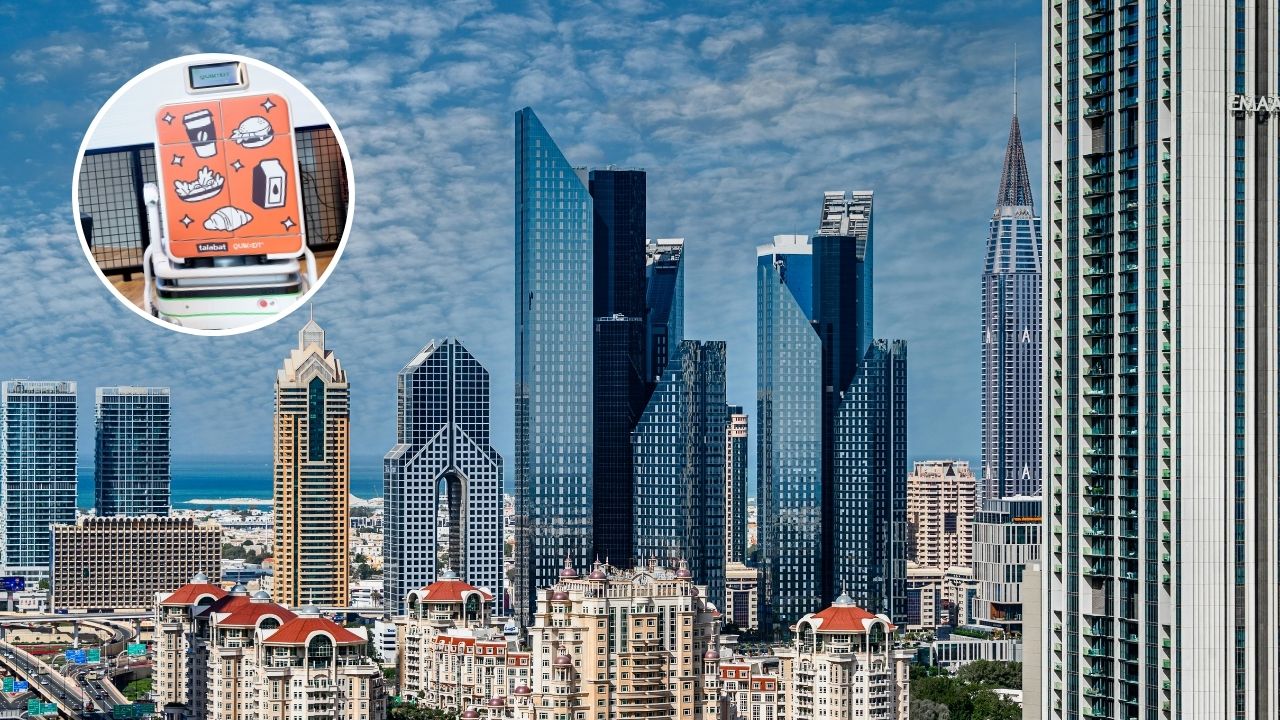
The delivery giant is testing a futuristic new way of getting your food to you, teaming up with Singapore-based deeptech company QuikBot to trial autonomous delivery robots inside high-rise buildings.
The idea is to the rider do the part they’re really good at, getting your order to the building, and let a robot take care of the slightly more annoying bit.
The pilot is already underway at Dubai Digital Park’s A6 commercial building in Dubai Silicon Oasis, where the two companies are putting the technology through its paces in a real-world delivery environment.
So, how does it actually work?
Instead of the rider heading through reception, waiting for a lift, travelling up several floors and finding the customer’s door, they can hand the order over to a QuikBot robot at a designated point inside the building.
From there, the robot takes over.
It navigates through the building, catches the elevator and makes its way directly to the customer’s door. Once it arrives, the customer uses a one-time password to collect their food.
Basically, your dinner gets its own little autonomous chauffeur.
And while that might sound like something straight out of a sci-fi film, the thinking behind it is actually pretty practical.
High-rise deliveries can eat into a rider’s time, with building access, elevator journeys and finding individual apartments all adding extra minutes to each order. By handing over that final stretch to a robot, riders can potentially get back on the road sooner and complete more deliveries.
That means less time waiting for lifts, and potentially less waiting for your biryani.
It’s not about replacing riders
The companies are keen to position the technology as something that supports riders rather than replaces them.
Talabat’s UAE Vice President and Managing Director, Simonida Subotic, said the pilot is an opportunity to explore how autonomous robotics can make some of the trickier parts of high-rise deliveries easier.
For QuikBot founder and CEO Alan Ng, the bigger picture goes beyond simply putting robots into buildings.
The company says its QuikSync technology acts as a “trust layer” for its Physical AI systems, giving robots a digital identity and managing how they interact with buildings and people.
In other words, it’s not just about building a robot that can find a lift. The technology needs to know where it can go, have permission to access certain spaces and interact safely within the building.
QuikBot says the same infrastructure can also work in the opposite direction, with robots collecting orders from inside malls and taking them out to riders. The company estimates this could potentially return 15 to 20 minutes of productive capacity to each rider every hour.
Could this become the future of Dubai deliveries?
That’s the big question.
For now, this is still a pilot, with talabat and QuikBot assessing how much time the technology can save and how smoothly their systems work together.
If the trial proves successful, the companies will look at whether autonomous robots could eventually be rolled out across more of talabat’s operations.
And Dubai is arguably the perfect place to test the idea. The city is packed with high-rise buildings, smart infrastructure and tech-focused developments, while residents are already very comfortable ordering pretty much everything from their phones.
So don’t be too surprised if the next time you order a late-night burger to a skyscraper, the delivery notification reads something along the lines of: “Your rider has arrived. Your robot is on its way.”
For now, though, your food is still probably coming up in the lift with a human. But the robots are definitely getting closer.